
Insights · November 10, 2026
What a Licorice Manufacturer Actually Controls: Moisture, Cook Temperature and Die Geometry
A sourced technical note on the three parameters that decide licorice texture: moisture and water activity, cook temperature and die geometry, with published data.
By Greg Candelario, Founder and CEO
A licorice manufacturer controls three things that decide the product: the moisture of the piece, the temperature it was cooked to, and the geometry of the die it was pushed through. This note sets out what the published literature says about each one, where licorice sits against other confections, and why the three have to be tuned together. Numbered references are listed at the end. Figures 2 and 3 use published data. Figures 1, 4 and 5 are schematics.
What is extruded licorice, mechanically?
Extruded licorice is a cooked, wheat- or starch-based confectionery dough forced through a shaped die, then cut and conditioned. A general industry description puts sweeteners at about 60% of the paste and wheat flour at about 25 to 40%, with licorice extract at 1.5 to 4% in black licorice [4]. The same source notes that traditional batch cooking took two to four hours and that continuous cooking has reduced that to a few minutes [4]. The shorter the cook, the less time there is to correct a drift, which is why the parameters below are set in development and held in production.
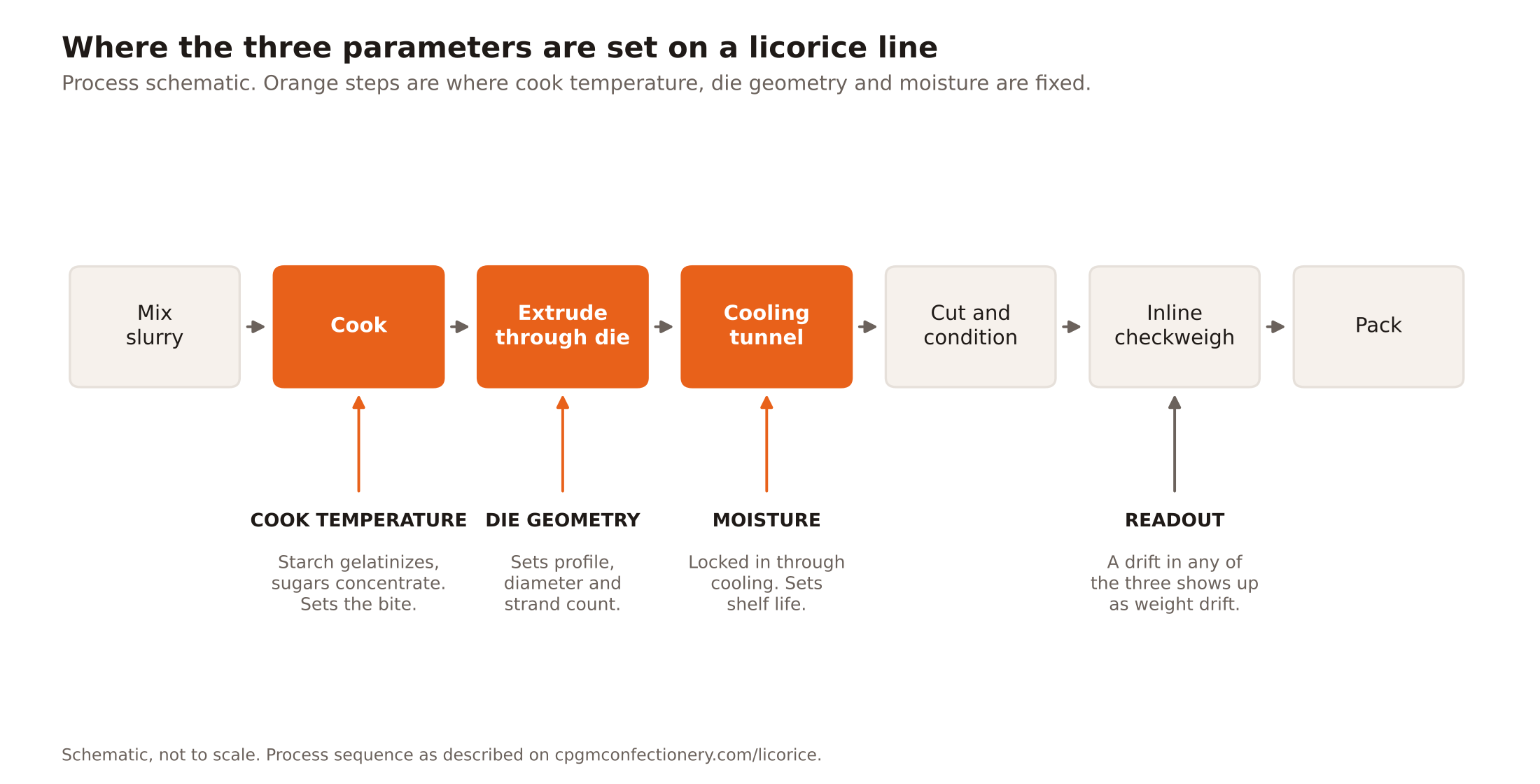
Figure 1. Process schematic. Cook temperature is set in the cooker, die geometry at the extruder, and moisture is locked in through cooling. The checkweigher reads all three as weight.
Where does licorice sit on the water activity scale?
Moisture content says how much water is in the piece. Water activity (aw) says how available that water is, and it is the better predictor of texture change and shelf life. Ergun, Lietha and Hartel's review of moisture in sugar confections describes water content and water activity as the main factors governing texture, stability and shelf life across the category [1].
Published dew point measurements on retail products put licorice and twist formats between 0.59 and 0.69 aw: 0.59 for a strawberry licorice piece, 0.64 for an original red twist and 0.69 for a strawberry twist [2]. On the same table, chewy caramels measure 0.45 and translucent gummy bears 0.70 [2].
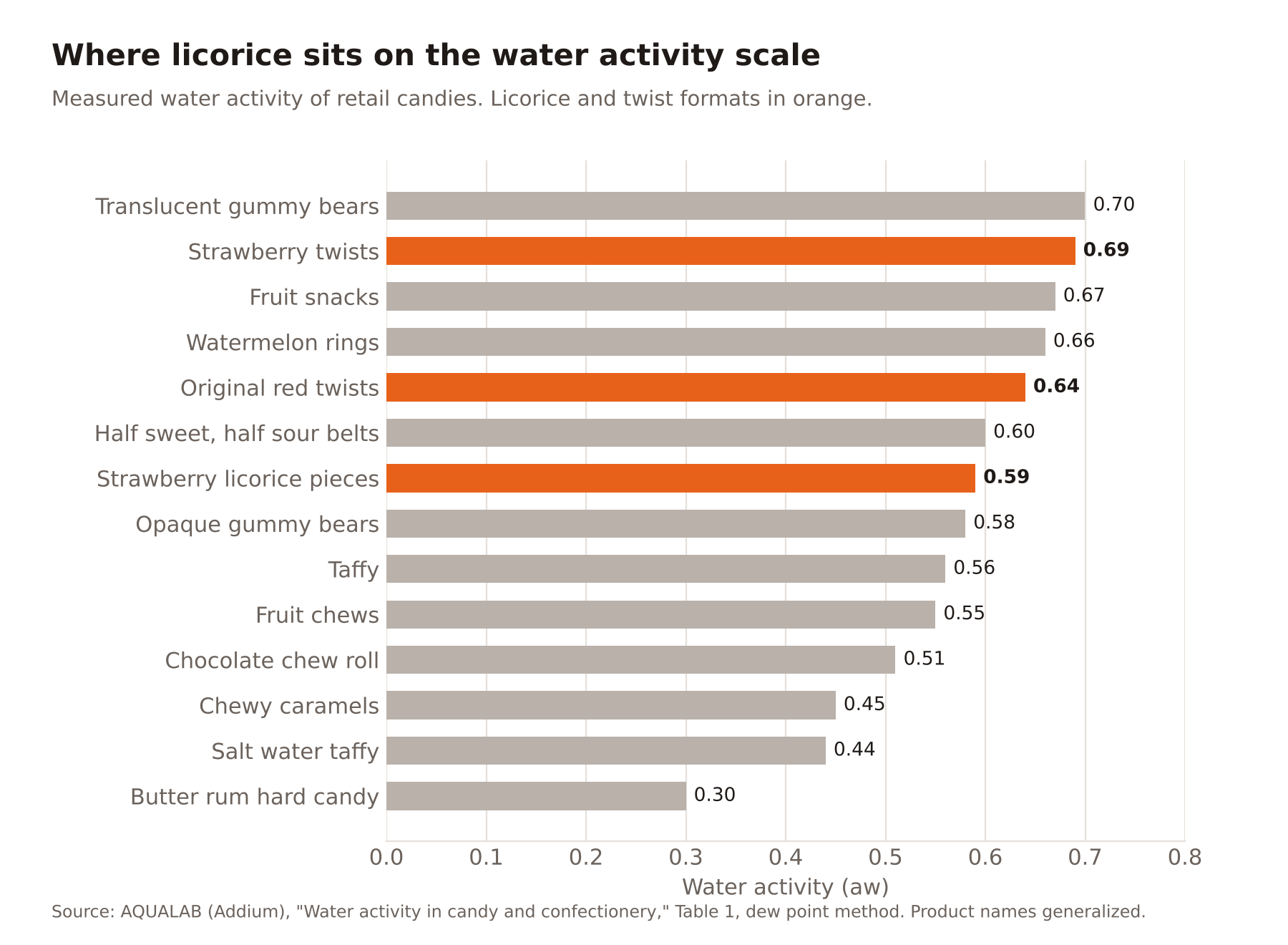
Figure 2. Measured water activity of retail candies, licorice and twist formats highlighted. Data: AQUALAB [2].
That places licorice at the upper end of the intermediate-moisture confections. Figure 3 overlays the measured licorice band on the published category ranges: chewy candies at 6 to 10% moisture and 0.45 to 0.60 aw, gummies and jellies at 8 to 22% and 0.50 to 0.75 aw, marshmallow at 12 to 20% and 0.60 to 0.75 aw [1]. The source table does not list licorice as its own category, so the band in Figure 3 is the measured range from [2], not a published specification.
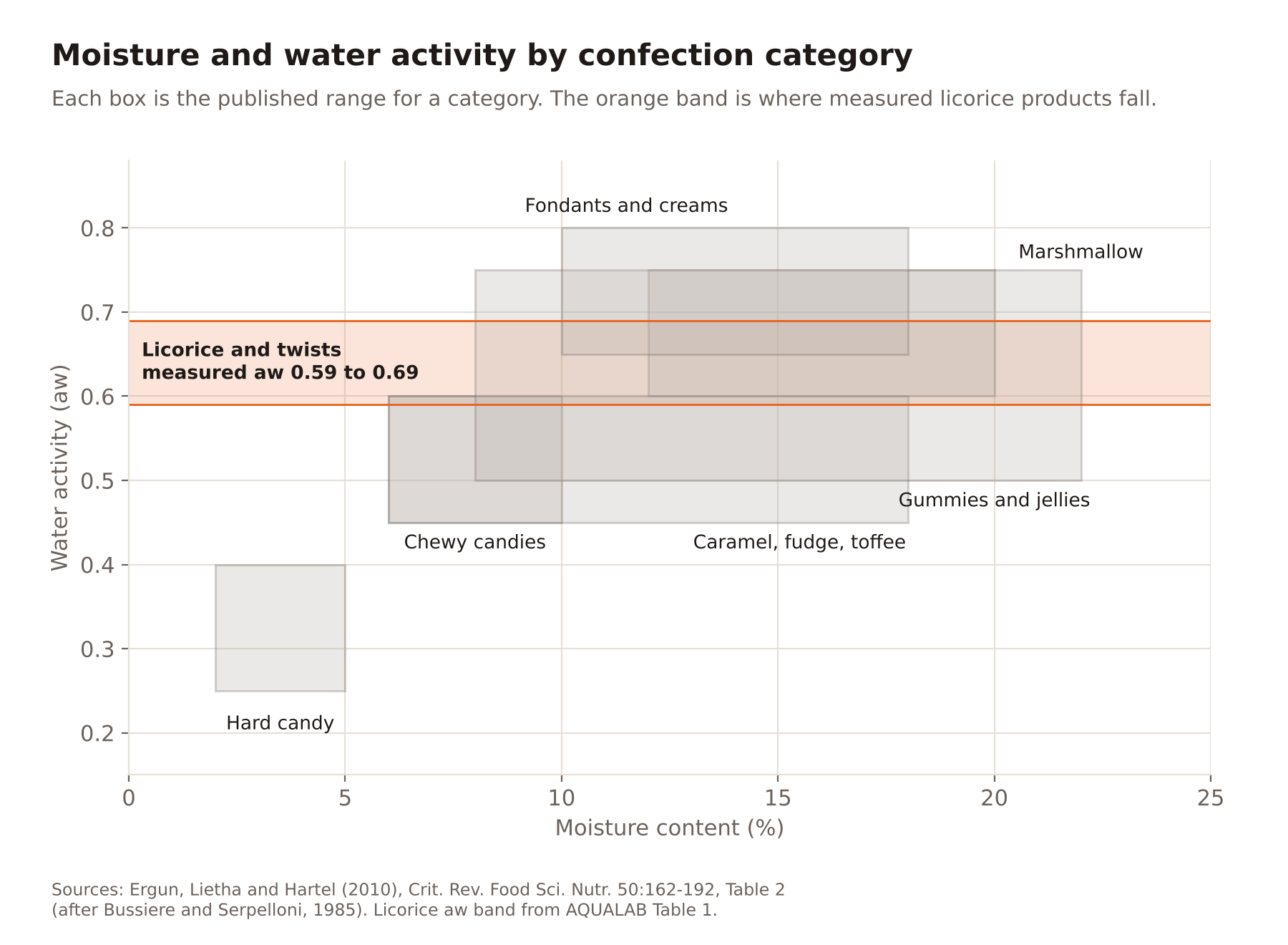
Figure 3. Published moisture and water activity ranges by category [1], with the measured licorice band [2].
Why does moisture decide the bite?
Water is the plasticizer in a cooked starch and sugar matrix. More of it gives a softer, more pliable piece. Less gives a firmer, drier bite. The practical point is that moisture is not set once. The cook sets it, cooling changes it, and it keeps moving on shelf, because water migrates from higher to lower water activity until the piece and its surroundings balance [1][2]. A piece packed too warm, or in a pack that lets it dry, is a different product by the time a consumer opens it. That is why moisture control through cooling sets the shelf life, and why the pack is part of the brief.
Published pilot work shows how narrow the working window is. In a 2016 extrusion study of liquorice, water content was one of the two variables studied, and the whole range tested was 21% to 26% (21%, 23.5% and 26%) at a fixed screw speed [3].
In the pilot laboratory, water activity is measured directly on bench cuts and pilot lots, alongside °Brix on the refractometer and texture on the texture analyzer, so the plant has a number to hold.
What does cook temperature control?
Cook temperature sets the bite, and the mechanism is starch gelatinization. The cook is where the starch granules in the flour take up water and lose their structure, and where the sugars concentrate.
Sugar makes this harder. Sugars compete with starch for water and raise the temperature at which starch gelatinizes. In differential scanning calorimetry work on corn starch, the gelatinization onset rose with sugar concentration, reaching 93.3°C with sucrose at the highest sugar ratio tested, with sucrose raising it more than fructose, glucose or maltose [5]. A licorice dough is a high-sugar system, so the cook has to reach a temperature that gelatinizes the starch in the presence of that sugar, and a cook that runs cool leaves starch undercooked.
The sweetener system shifts the target. In the liquorice study above, a maltitol-based recipe needed a higher water content than the sugar control to reach a similar diameter and texture, which the author attributes to maltitol syrup binding water more strongly and leaving less for starch gelatinization [3]. The same logic applies to a wheat-free formulation, where the starch source is different. The cook target is a development output for each SKU, not a production tweak.
What does die geometry decide?
The die sets the profile: twist, rope, lace or cut piece. It does not set the diameter on its own. A cooked dough is viscoelastic, and it swells as it leaves the die, so the piece is larger than the opening.
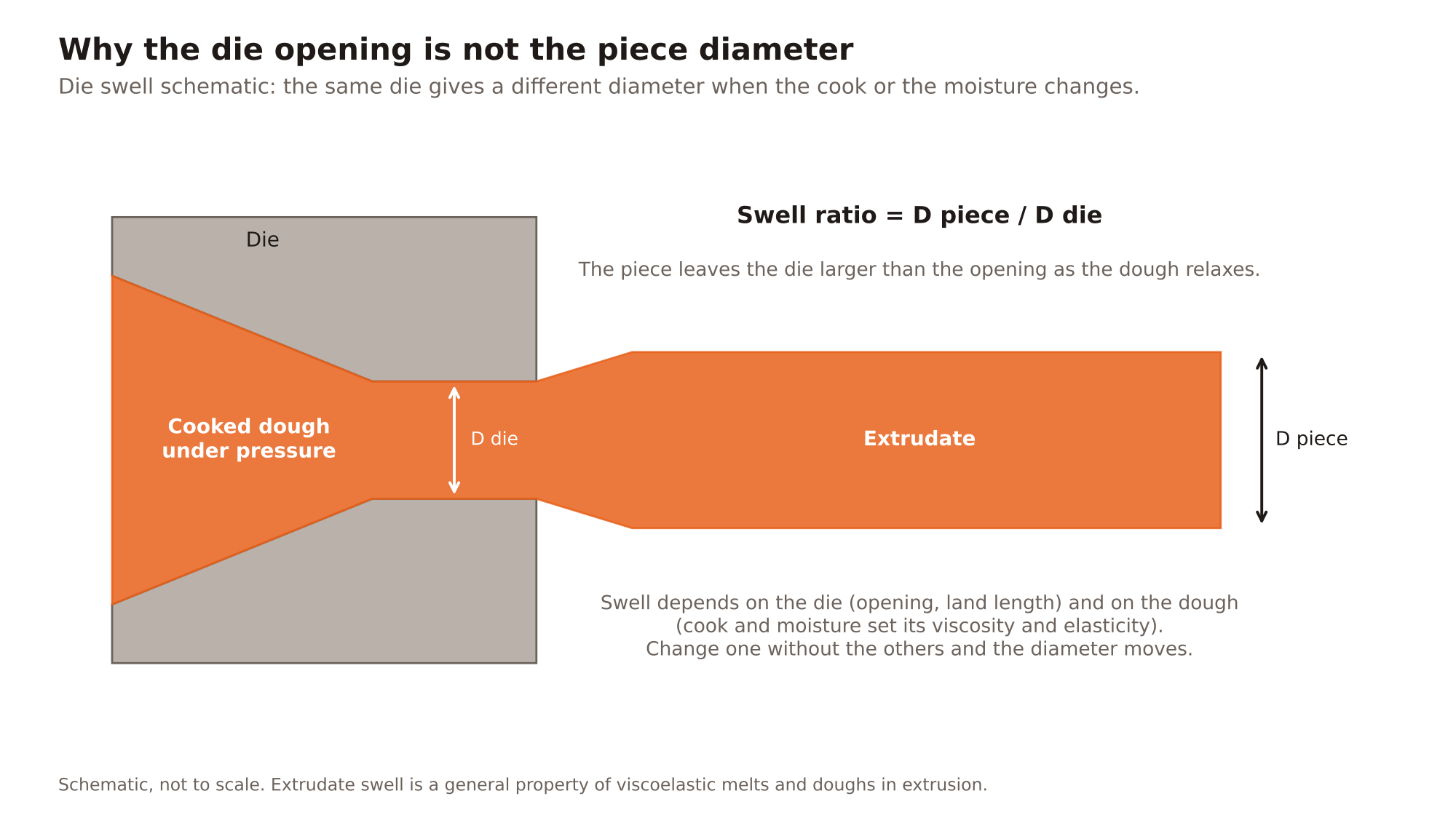
Figure 4. Die swell schematic. The swell ratio is the piece diameter divided by the die diameter.
How much it swells depends on the dough as well as the die. In extrusion-cooked wheat starch, extrudate diameter was found to correlate with paste viscosity [6], and viscosity is set by the cook and the moisture. Change the cook without changing the die and the same die produces a different diameter. Change the die without changing the cook and the twist may not hold its ridges.
How do the three parameters interact?
Every outcome a buyer cares about has more than one driver. Figure 5 summarizes the mechanisms above.
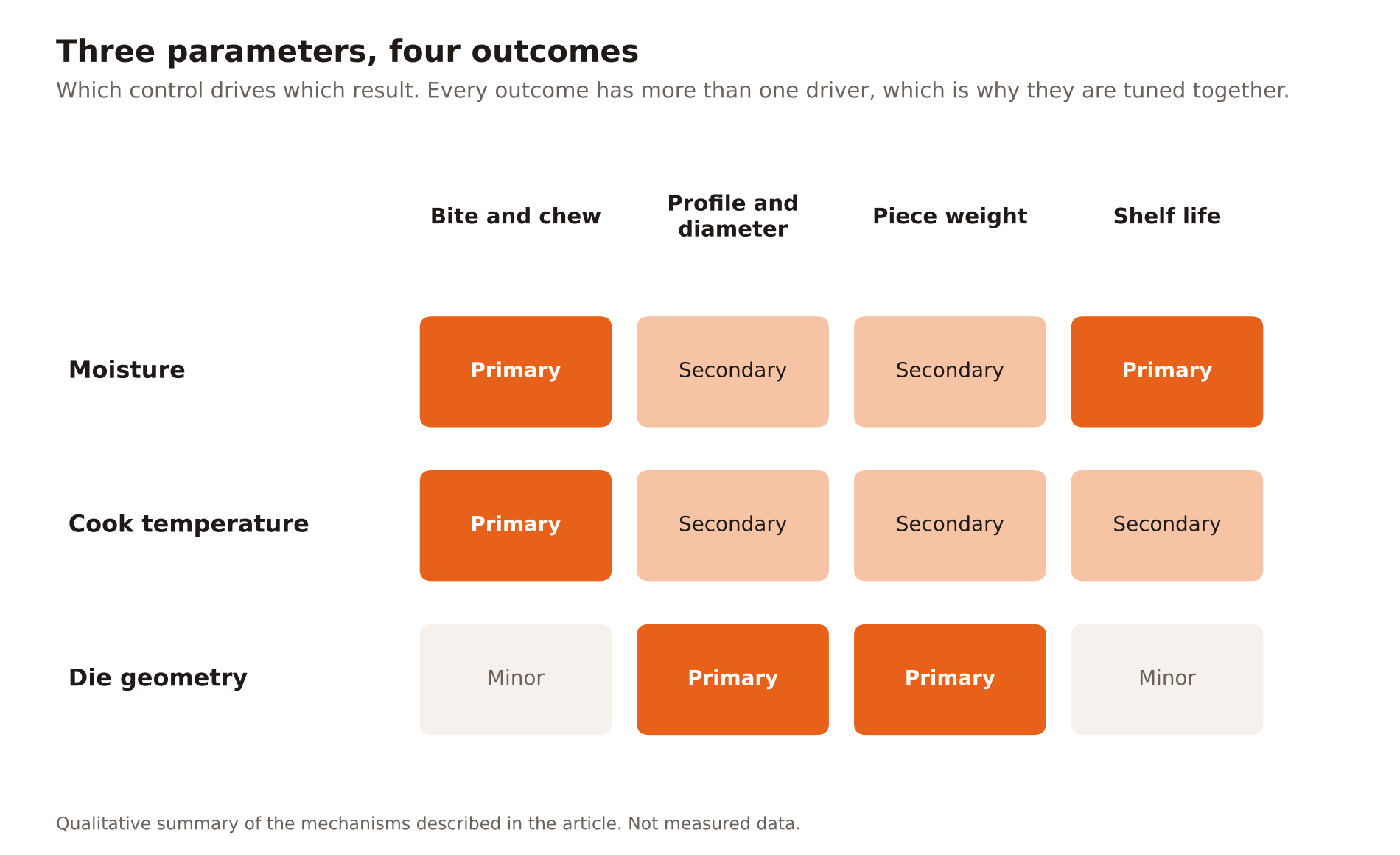
Figure 5. Qualitative summary of which parameter drives which outcome. Not measured data.
This is why a licorice SKU is developed as a set of parameters on a tooling family, not as a recipe on a card. It is also why length and weight are set per SKU at CPGM and held by inline checkweighing. A checkweigher does not measure moisture, cook or die wear directly, but a drift in any of them shows up as a weight drift, in real time.
Why is this harder when the line is overseas?
Most licorice on U.S. shelves is imported. For a brand, that has meant a product specified from a sample bag, with the three parameters set by a contractor a time zone away and revisions measured in months. CPGM was built to change that. The production extruder is in Arizona, and a brand's R&D team works beside ours on bench cuts and pilot lots. Revisions are measured in days, and audit access does not need a flight overseas.
What does the quality system add?
Licorice at CPGM runs under current Good Manufacturing Practice (cGMP), Hazard Analysis and Critical Control Points (HACCP), a third-party audited food safety program, and a Preventive Controls Qualified Individual (PCQI) on staff. Allergen changeover is validated per line, with documented cleaning verification before every allergen change, which matters on a line that runs both wheat-based and wheat-free licorice. Batch records, certificates of analysis and specifications are available through the quote form.
How does a licorice program start?
With a brief: the profile (red, black, fruit or a custom color match), the format, the formulation (wheat-based or wheat-free), the pack, the volume and the certifications the buyer requires. CPGM returns a scoped response within two business days. Bench cuts settle the dough and the color. Pilot lots on the lab extruder settle the cook, the moisture target and the die, with a shelf-life start and costing against the real production line. Samples are available for qualified brands, and private label programs follow the same path.
References
- Ergun, R., Lietha, R. and Hartel, R. W. (2010). Moisture and shelf life in sugar confections. Critical Reviews in Food Science and Nutrition, 50(2), 162-192. Category ranges from Table 2, adapted from Bussiere and Serpelloni (1985).
- AQUALAB by Addium. Water activity in candy and confectionery, Table 1.
- Anzmann, F. (2016). Effects of steviol glycosides and maltitol in combination with different extrusion parameters on properties of liquorice. Thesis, Metropolia University of Applied Sciences.
- Licorice. How Products Are Made, Volume 4.
- Johnson, J. M., Davis, E. A. and Gordon, J. (1990). Interactions of starch and sugar water measured by electron spin resonance and differential scanning calorimetry. Cereal Chemistry, 67(3), 286-291.
- Mason, W. R. and Hoseney, R. C. (1986). Factors affecting the viscosity of extrusion-cooked wheat starch. Cereal Chemistry, 63(5), 436-441.
Request a quote for a licorice program, or read the licorice manufacturing capabilities in detail.